Tournament History
The archive of MT Tournament, its champions, and the stories that turned a private weekend into a destination event.

The archive of MT Tournament, its champions, and the stories that turned a private weekend into a destination event.
MT Tournament started the way a lot of good Magic traditions start: one overloaded table, too many sleeves, too much confidence, and a room full of players who all believed they had brought the cleanest list. The first gathering was not built to be public. It was a closed test weekend for friends, travel grinders, Commander regulars, and a few players who were invited because somebody insisted, “No, seriously, you need to see how this guy plays.”
The event kept its private character as it grew. Early years were intentionally small, with pairings handled by hand and standings checked twice because nobody trusted the first set of tiebreakers. What made it stick was the mix: tuned constructed decks in one corner, multiplayer politics in another, and late-night arguments over whether a winning line was brilliant, lucky, or both.
The first medals were ordered almost as a joke, but they became the signature of the event. No oversized trophies, no staged podium props, just a medal for the player who survived the room. By the time the tournament added separate Modern, Legacy, Limited, Commander, and cEDH divisions, the medal wall had become the part of the weekend people checked first.
Past records list Commander medalists Marcus Hale, Aaron Sutter, and Brandon Vier; Modern medalists Ethan Caldwell, Grant Mercer, and Nolan Pierce; Legacy medalists Michael Tran, Victor Ellison, and Samuel Keene; Limited medalists Dylan Foster, Caleb Price, and Owen Hartley; and cEDH medalists Justin Clarke, Evan Rourke, and Nathan Bell. The archive is maintained for invite verification, seed history, and the occasional dispute about who actually punted in the semifinals.
The June 2025 champions photo remains the reference point for the current event cycle. The 2025 medalists gave the tournament its current look: cleaner signage, a formal champions wall, division pages, and a more deliberate spectator lottery.
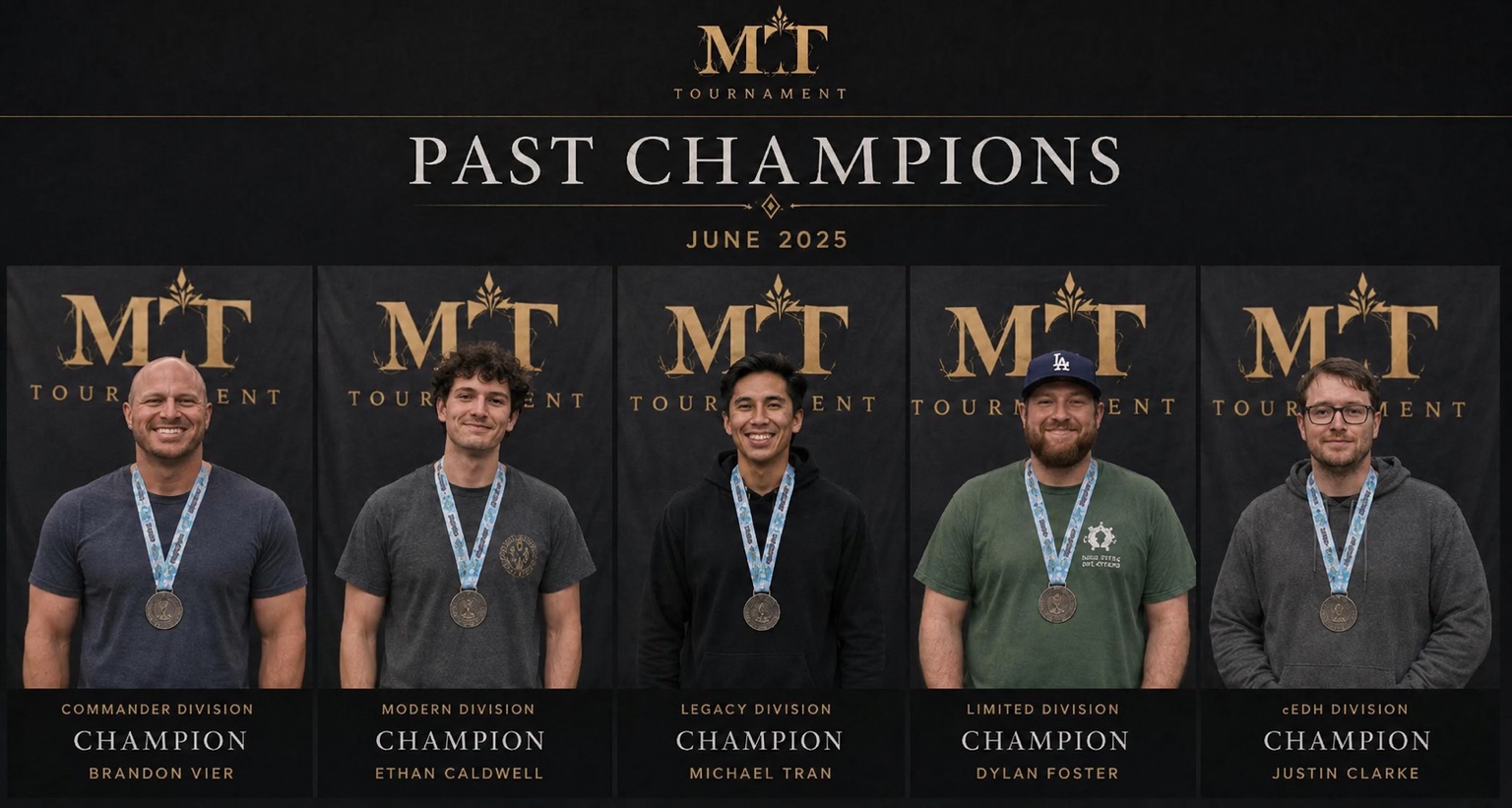
The MT Tournament medal is not a take-home prize. Each division champion wears it for the ceremony, the official photo, and the closing toast, but the medal returns to the event before the night ends.
The reason is simple: the medal belongs to the tournament, not the year. Every champion adds their name to it, but no one removes it from the wall. Between events, the medals are kept together in the Champions Wall display, where they remain until the next tournament. Returning champions can see the medal they wore, new players can see the names already attached to it, and every finalist understands that winning means joining the archive rather than walking away with a souvenir.
It started as a practical choice after the first medals were nearly lost during a late-night deck breakdown. Since then, it has become one of the tournament’s better traditions. The medal is presented, worn, photographed, toasted, and returned. The champion keeps the title. The wall keeps the weight.
“A tournament becomes real when people start remembering the near-misses.”